Build. Code. Invent.
Your kit. Your home.
Your future.
50 instructor-led hours across 14 months — delivered to your door. Yours to keep forever.
By 2030 · What It Means for Your Child
The world your child will graduate into
By AI and automation. Children in school today will face this.
New AI and tech jobs. Only builders and coders will fill these.
School curriculum hasn't caught up yet.
Only 35% of Indian graduates are employable. Start building at 10, not at 22.
Curioverse gives your child a 12-year head start.
Source: World Economic Forum, Future of Jobs Report 2025
Curioverse — the BuildX take-home STEM programme
Curioverse is BuildX's flagship take-home STEM programme for school students aged 10 to 18. Every student receives a personal hardware kit that lives at their home, belongs to them permanently, and forms the foundation of 14 months of structured, instructor-led learning. Every session is live. Every concept is experienced before it is explained.
Your kit. Your home. Your child's future.
Not a school lab kit. Not a rental. Not shared with 30 other children. It belongs to your child forever.
Weekends, evenings, holidays. No waiting for a lab slot.
Sibling, cousin, or friend can learn from the same kit. One investment, many learners.
Class ends, kit stays. Students keep building long after the programme is over.
Every 3 months, the BuildX team visits your location for hands-on support and project reviews.
All components curated for the age group. No high voltages, no toxic materials.
Up to 4 EMI. Kit shareable. 14 months of learning at less than a tuition class per session.
Meet your kit
Every Curioverse box contains professional-grade components your child keeps forever.
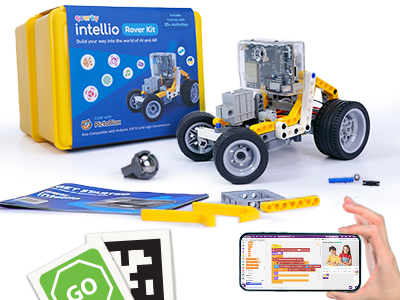
Intellio Rover
Your child's AI robot — sees, hears, and thinks

Pico 2W
Build smart home and IoT automation projects
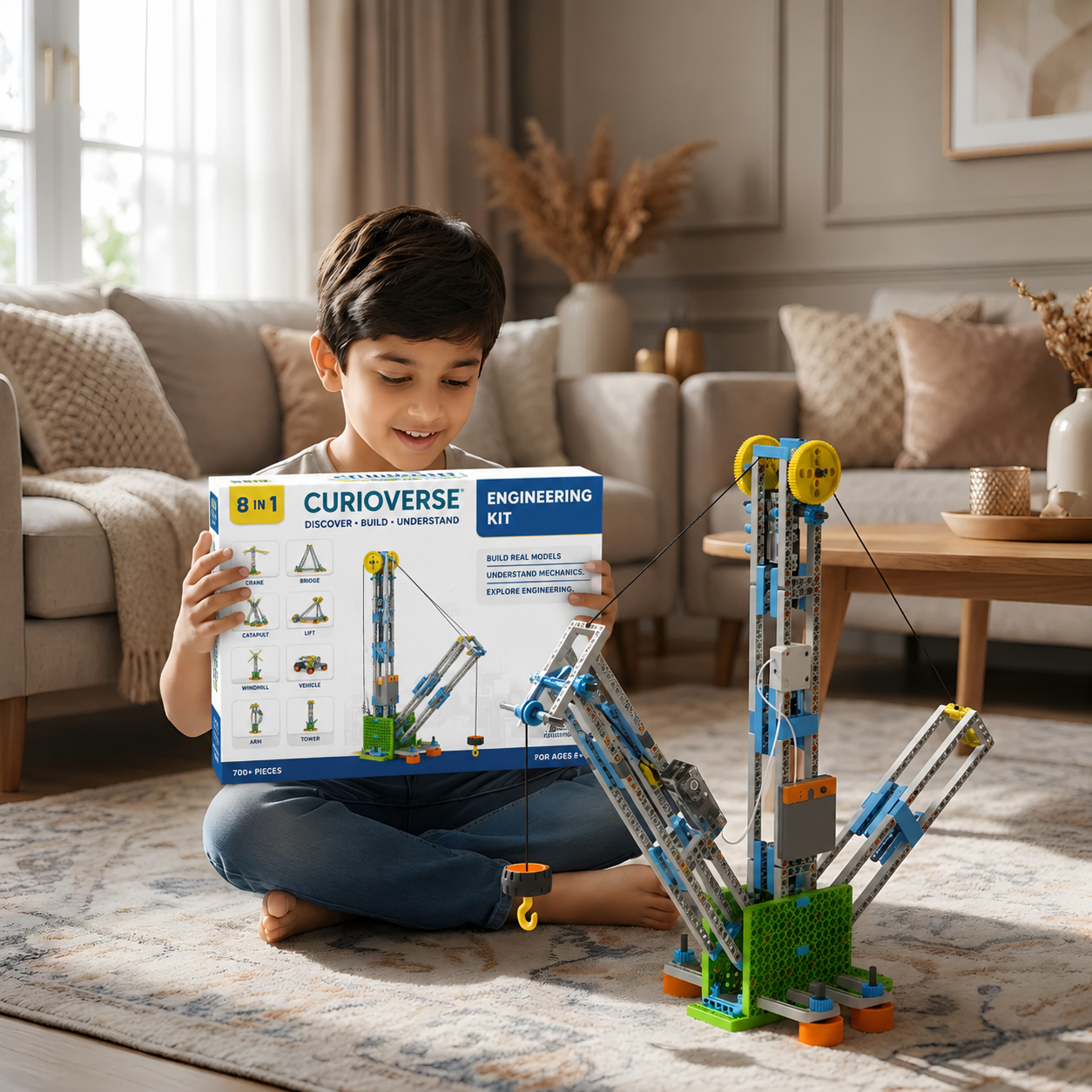
Engineering Set
Gears, pulleys and motors — real machines, real builds
Choose your Curioverse plan
Curioverse Pro
Arduino UNO R4 WiFi + sensors + actuators + simple machines
Grades 4–10 • Ages 10–16


- Arduino UNO R4 WiFi board
- Simple machines kit — gears, rack & pinion, power screw, worm gear, levers, pulleys
- Sensors: DHT22, HC-SR04, PIR, LDR, soil moisture
- Actuators: servo SG90, L298N motor driver, DC motor
- 5V relay + active buzzer + OLED 0.96" display
- Breadboard, jumper wires, resistor kit, LEDs

Sensors included:

PIR Motion Sensor

MQ-2 Gas Sensor

DHT11 Temp & Humidity

HC-SR04 Ultrasonic
- Circuit building — Ohm's Law, series/parallel, relay control, PWM
- Simple machines by doing — gears, rack & pinion, power screw, worm gear, bevel gear, levers
- C++ Arduino IDE — industry-standard embedded coding and IoT projects
- Motor + servo control — robotic arm, auto door, vehicle drivetrain
- WiFi IoT projects — smart home, cloud sensor dashboard, relay automation
- 3D design, PCB design, science simulations, makeathon
Curioverse Spark
Quarky Intellio + Raspberry Pi Pico 2W + sensors
Grades 5–10 • Ages 10–16

- Quarky Intellio AI rover (ESP32-S3, 5MP camera, mic, RGB LED)
- Raspberry Pi Pico 2W (WiFi + Bluetooth, MicroPython)
- Sensors: DHT22, HC-SR04, PIR, soil moisture
- 5V relay module (optocoupler) + active buzzer
- Mini breadboard, jumper wires, LED assortment, resistors
Sensors included:

PIR Motion Sensor

MQ-2 Gas Sensor

DHT11 Temp & Humidity

HC-SR04 Ultrasonic


- Circuit building — Ohm's Law, series/parallel, LDR circuits, relay switching
- Simple machines by doing — gears, rack and pinion, levers, pulleys hands-on
- Train your own AI model — image classifiers, face and object detection, gesture control
- Dual board coding — PictoBlox blocks on Intellio + MicroPython on Pico 2W
- IoT sensor projects — WiFi, cloud data, smart plant watering, motion alert
- 3D design, PCB design, science simulations, makeathon
Everything included in both plans
The 14-month learning journey — and beyond
The base programme runs for 14 months at a steady pace. On completing 50 hours, every student receives their certificate and portfolio. From month 15, students who want to keep going enrol in Curioverse Continue.
Extension begins only after completing the full 14-month base programme.
Capstone IoT system, AI model deployment, full PCB design and 3D-printed enclosure projects.
Continue at ₹3,500 per block for as long as the student wants. No long-term commitment.
Curioverse compared — three perspectives
| Feature | Curioverse — BuildX | Typical market alternatives |
|---|---|---|
| Kit ownership | Take-home kit — yours forever, never returned | Kit returned after course / school property |
| Kit sharing | Sibling, friend, or cousin can use the same kit | One seat per student, no sharing permitted |
| Simple machines | Gears, rack & pinion, power screw, levers, pulleys by hand | Textbook-only or not offered |
| Circuit building | Ohm's Law, relay, PWM — hands-on in both plans | Available as paid add-on or not offered |
| Class type | 100% live and instructor-led, multiple batch timings | Mostly pre-recorded videos, single fixed batch |
| Programme duration | 14 months — steady, deep-learning pace | 1 to 3 months — rushed, surface-level |
| Instruction hours | 50 instructor-led hours across 14 months | 10 to 20 hours total, often self-paced |
| Physical meetup | BuildX visits students at their location every 3 months | Fully online, no in-person support ever |
| 3D designing | Tinkercad — included in both plans | Separate paid course or not offered |
| PCB designing | EasyEDA — included in both plans | Not offered at this price point |
| Science simulations | PhET and custom simulations included | Not offered |
| Makeathon | Included in every programme cycle | Paid separately or not available |
| Extension plan | ₹3,500 / 2 months from month 15 — no new kit | Must re-enrol at full programme price |
| Payment flexibility | Up to 4 EMI, no hidden charges | Full payment upfront only |
| Age-specific plans | Two plans — ages 10–16 (Spark) and 12–18 (Pro) | One generic programme for all ages |
"School teaches the theory. Curioverse builds the experience."
Schools cover science topics thoroughly on paper. But coverage is theoretical — students learn definitions, diagrams, and formulas without ever building a circuit, writing working code, or conducting a real experiment. Curioverse takes every topic the school already teaches and makes students experience it with their hands.
| Topic | CBSE | ICSE | What Curioverse students do |
|---|---|---|---|
| Electricity and circuits | Diagrams + Ohm's Law numericals. No wiring. | Current, potential difference — written only. | Wire real series and parallel circuits. Measure V, I, R with multimeter. Verify Ohm's Law with actual data. |
| Magnetic effects of current | Fleming's rules — read and memorise. | Electromagnets — theoretical. | Control a real DC motor with L298N driver. Reverse direction with code. Feel magnetic braking directly. |
| Force and simple machines | Lever, pulley — definitions and diagrams. | Mechanical advantage — formula-based. | Assemble gears, rack & pinion, power screw, worm gear by hand. Measure torque change. Experience mechanical advantage. |
| Light | Ray diagrams, mirror/lens formula — paper-based. | Periscope — one brief practical. | Use LDR sensor to detect light intensity. Build automatic street light. Simulate refraction in PhET. |
| Sound | Amplitude, frequency — definitions only. | Wave properties — written calculations. | Programme buzzer for different frequencies. Build sound-triggered alarm. Visualise waveforms in PhET. |
| Motion and measurement | Speed, velocity — numericals. | Distance-time graphs — pencil. | Measure real distance with HC-SR04. Plot sensor data live on serial plotter. |
| Topic | CBSE | ICSE | What Curioverse students do |
|---|---|---|---|
| Water purification | Read from textbook. | Theory. | Build working water filtration model with sand, gravel, cotton. Test turbidity before and after. |
| States of matter | Diagrams and definitions. | Kinetic theory. | Monitor temperature with DHT22 during heating/cooling cycles. Plot state change in real time. |
| Acids, bases, and salts | Written definitions. | Described experiments. | Build soil pH monitor with soil moisture sensor. Display on OLED. |
| Air and pollution | Listed in textbook. | Read and discuss. | Connect MQ-2 gas sensor. Detect smoke and LPG. Build gas leakage alarm. Push data to cloud. |
| Combustion and fuel | Memorised. | Written only. | Design automatic ventilation system triggered by relay-controlled fan when gas detected. |
| Topic | CBSE | ICSE | What Curioverse students do |
|---|---|---|---|
| Plant growth and water | Diagrams. | Described observations. | Build automatic plant watering with soil moisture sensor + relay. Monitor data on cloud. |
| Habitat and adaptation | Textbook classification. | Read and classify. | Train AI model on Intellio to classify environments from images. |
| Nutrition and food | Listed and memorised. | Drawn diagrams. | Use DHT22 to monitor food storage temperature. Design smart fridge alarm. |
| Respiration | Definitions and equations. | Written only. | Build DIY stethoscope. Use Intellio microphone to record breathing sound. Simulate gas exchange in PhET. |
| Environment and conservation | Described. | Essay and MCQ. | Build drip irrigation system. Track soil moisture. Create data-driven conservation report. |
| Topic | CBSE | ICSE | What Curioverse students do |
|---|---|---|---|
| Block-based coding | Scratch Gr 6 — rarely practiced | ICT: basic keyboarding | PictoBlox on Intellio — 20+ sessions of real coding controlling physical hardware |
| MicroPython | Not before Grade 11 | Not before Grade 11 | MicroPython on Pico 2W — variables, loops, functions, GPIO control, sensor reading |
| Embedded C++ | Not in curriculum | Not in curriculum | Arduino UNO R4 WiFi with C++ — 15+ projects from LED control to full IoT web server |
| AI / ML | Mentioned Gr 9–10 vocational — surface only | Not offered | Train image classifiers. Run face and gesture detection. FATE ethics framework. |
| IoT and WiFi | Not taught | Not taught | Push sensor data to cloud. Build WiFi web server. Control relay via browser. |
| 3D design (CAD) | Not at school level | Not at school level | Tinkercad — design, iterate, and 3D print functional parts |
| PCB design | Not in curriculum | Not in curriculum | EasyEDA — design a printed circuit board, understand footprints and traces |
| Topic | CBSE | ICSE | What Curioverse students do |
|---|---|---|---|
| Ratio and proportion | Written problems. | Written problems. | Gear ratio — why a small gear slows a large gear but multiplies force. Calculate and verify with physical gear kit. |
| Graphs and data representation | Bar charts — hand drawn. | Line graphs — pencil. | Plot live sensor data on serial plotter. Graph temperature over time. Analyse soil moisture trends. |
| Mensuration and geometry | Formula-based. | Written and drawn. | Design enclosure in Tinkercad. Calculate volume and surface area. Print and verify measurements match design. |
| Statistics | Textbook datasets. | Written problems. | Collect 30 real temperature readings with DHT22. Calculate mean, median, range. Identify outliers from sensor noise. |
| Algebra — variables | Abstract equations. | Linear equations. | Write Arduino code using variables, if-else, and loops. See algebra become logic — a variable in code is literally a variable in maths. |
CBSE and ICSE tell students about electricity, forces, life processes, and data. Curioverse makes them measure, build, code, and design the same concepts with real hardware and live feedback. Every school topic reinforced. Every gap filled.
Simple, transparent pricing
- ₹6,500 × 2 instalments
- ₹3,250 × 4 instalments
Arduino UNO R4 WiFi + simple machines + sensors + actuators + circuit lab + 3D design + PCB design + science simulations + makeathon
Book a Demo- ₹8,000 × 2 instalments
- ₹4,000 × 4 instalments
Quarky Intellio + Pico 2W + sensors + actuators + circuit lab + 3D design + PCB design + science simulations + makeathon
Book a DemoAfter completing 14 months and 50 hours, continue from month 15 with advanced projects at ₹3,500 per 2-month block. No new kit, no re-registration. Renewable every 2 months for as long as the student wants to keep learning.
Frequently asked questions
Yes. The Curioverse kit is delivered to your home and belongs to your child permanently. There is no return date, no lab requirement, and no annual subscription to maintain the kit.
Absolutely. One kit can be used by multiple children at different times. A sibling, cousin, or friend can attend separate batches using the same physical kit, effectively halving your cost per child.
All 50 hours are live, instructor-led sessions conducted online. Multiple batch timings are available — morning, evening, and weekend — so you can pick what works for your family.
Recorded session replays are available for missed classes. You can also attend a session in a parallel batch for that topic.
A trained BuildX facilitator visits your home or a nearby location every 3 months for a hands-on session — reviewing your child's projects, troubleshooting the kit, and planning the next phase.
Curioverse Pro (₹12,999) is ideal for Grades 4–10 and focuses on Arduino C++, IoT, motor control, and engineering projects. Curioverse Spark (₹15,999) is ideal for Grades 5–10 and focuses on AI, robotics, and MicroPython with the Quarky Intellio rover.
Your child receives a completion certificate and project portfolio. If they want to continue, Curioverse Continue is available from month 15 at ₹3,500 per 2-month block — same kit, same instructor, deeper projects.
Yes. Curioverse activities directly reinforce CBSE and ICSE Science chapters for Classes 6–10 — electricity, forces, chemistry, biology, and mathematics — through hands-on projects that use the same concepts but make them real.
Let's build the future together
Request a demo, get a curriculum walkthrough, or enrol directly.